I have moved over to WhittereronAutism.com. Please follow the link to find me there. Hope to see you after the jump! :)

Thursday, November 30, 2006

Transitions


For a faster loading version of this site visit here:- Whitterer On Autism


It’s an innocuous enough word. There again, it is a ubiquitous word here in America. In every other country, ‘transition’ merely means change, they’re pretty much interchangeable. Out here, ‘transition,’ is used most commonly with reference to children, as in ‘he doesn’t transition well,’ otherwise known as a 'meltdown.' And yes, it’s nearly always ‘he.’ More simply, it means he finds it difficult to stop doing that, and start doing this.

I came face to face with this word several years ago. I was trying to leave the YMCA with my three littlest ones. Junior was strapped to my chest, his fingers entwined in my hair and screaming. The other two were in the double stroller. They were also both screaming. The front one held the wheels, the second one gripped the door jam, preventing our departure. A kindly woman remarked "my! they sure do have a little trouble transitioning!" She might as well have been speaking Swahili to me for all I understood.

Many children, and some adults I can think of, have trouble transitioning. However, if you are autistic, transitions always result in a meltdown. You may not think that is so very dreadful, until you examine how many transitions there are in the average day.

Lets take the first five minutes of your typical day; you wake up, you fall or bounce out of bed, visit the bathroom, clean your teeth, stagger down stairs, put the coffee on and reach for the newspaper. Sounds about right? Approximately? Give or take? Right. Each one of those is a transition. 7 transitions, seven changes, seven meltdowns, and that’s just the first five minutes.

So lets just imagine that we can fast forward and skip the first 7 meltdowns of the day. Pick another time of the day. Pick another time of the day when you were a child. Remember being a child? So the end of the school day approaches. Horray! Gather books and belonging, leave class room, find parent, get in car and drive home, into the garage, skip into the house for snack and T.V., oh no, perhaps not T.V., more likely homework. Were you counting? Right, 8 transitions, 8 meltdowns. Beginning to make some sense?

This is why autistic parents and their children are so inefficient. This is why every tiny thing takes 8 times longer than it would for a ‘typical’ person.


Still dubious?

One more example then. Say you’ve decided that since it’s the weekend, it might be an idea to take a little trip. Scratch that, the schedule is still pretty full with three small children at home, how about, instead, we go for just a couple of hours to the park? Deal? Great. Use the toilet, wash hands, gather bikes or sand toys, put on your shoes and socks, or other footwear, leap into the car and you’re off. Only five transitions, only five meltdowns, although of course two of them are autistic, not just one, so that’s two times 5, which would be ten meltdowns. You think I’m exaggerating? Lets tear it apart a bit.

Firstly, no-one wants to go to the park, going to the park is not fun. Going to the park means being ‘outside’ and ‘outside’ is always bad. In addition, even if the ‘park’ were an ‘indoor’ or covered park, it would still count as outside, because it’s not home. Everything that isn’t home, school or therapy, is ‘outside.’

Perhaps you could pick one of those real indoor places, like bowling, jungle gyms or other children’s entertainment places. For now we will ignore the fundamental difference, that the park is free and all these other places involve hard cash times 3. You’d still have the same fundamental problem; it is unknown, it is not preferred, it is not home and involves a transition.

So far so good. Next. Use the toilet before departure. No-one wants to, they need to stop what they’re doing, even if it’s something that they’re not actively enjoying, like homework, and do something else, namely go to the toilet, which means that it is a transition. We hate transitions, no-one is going to use the toilet willingly.

Added to this, everyone has to remove every item of clothing in order to use the bathroom. The two activities are connected; toilet = naked. It’s unfortunate that these two are connected, they shouldn’t be, that’s my fault for being a lax mother, but that aside, for the moment, the reality is, that they are connected.


Once everyone is naked, they need to get dressed again in order to go out to the park. Getting dressed is a transition, no-one wants to get dressed, even if they didn’t have poor fine motor skills which makes buttons, Velcro and zips a form of torture.

This skips over the issue of sequencing; knowing that you need to put your clothes on in a certain order, unless you want to end up looking like superman with your underwear on the outside. It also ignores the problem that scattered clothes, even once they are gathered together, in fact probably because they are gathered together, become an amorphous heap, unrecognizable as clothing. Now they are a lump and possibly a tangle. The tangle of a puzzle that cannot be unraveled by those who only see ‘parts’ and do not recognize ‘wholes.’

We skipped ‘washing hands,’ I only wish we could. No-one wants to wash. If they have to wash, one needs cold water, the other doesn’t care about the temperature or being wet. One will have an apopleptic fit if so much as a drop of water touches any part of his anatomy or clothes, other than his hands. The other could be drenched, would prefer to be drenched, but that would mean another session of dressing.

It probably will involve another session of dressing anyway, because the other one experienced a droplet of water on his knee, during the washing hands session and will therefore be naked again. You need to bear in mind, that whilst it make take them 45 minutes to dress themselves, they can be naked in less than one second, some kind of inverse relationship there.


Ignoring the issue of dressing and washing, we move swiftly on to choosing items to accompany us to the park. Bikes or sand toys? Neither actually, because no-one wants to go to the park, so why should anyone choose something to take with them? This is apart from the fact that choosing, the act of making a positive decision about anything, is also impossible. Not only is it impossible, it is also aversive. Aversive means a guaranteed meltdown, times 2.

Where are we now? Oh yes, shoes and socks or other footwear. Lets ignore the issue of choosing the footwear, you the parent, intervene and choose the lesser of two evils, namely sandals. Sandals are great because this obviates the need to put socks on, that makes the exercise speedier, that’s four socks that don’t have to be put on four feet, in addition to the shoes. Half the time. There again, all footwear is aversive, contemptible. Not only does no-one want to put shoes on, they also don’t want to put them on because it is a precursor to being able to leave for the park, which they also don’t want to do. So there is no motivation to put hateful shoes on delicate feet.

This issue can be overcome by a bribe. The only kind of bribe that will work in this situation is candy [translation = sweeties] This is the lowest common denominator, a quick fix. You think I should use some other kind of motivator, I can see that. How about they put them on to please me, to make me proud of them? Nope. They don’t care what I think or feel and they certainly don’t want to please me. Perhaps I could appeal to another element of their nature, something along the lines of “Wow, let me see what big [independent] boys you can be, show me you can do it, I’m going to be so proud of you if you can do this?” Sound good? Sounds like a step in the right direction? Sounds like it should be, but of course it isn’t. They don’t want to be grown up, they’re quite happy as they are thank you very much. They don’t want to make me proud, they don’t want to demonstrate skills of independence. They don’t want to go to the park.

Any other ideas? The sooner you get your shoes on, the sooner we can go to the park? Obviously wrong for the reasons above. The most natural encouragements are actually the worst choices for these boys, it’s all counter intuitive, you need to think backwards, you need to think inside out.

O.k.. Last step. Get into the car. The last step is actually the hardest step. You may be familiar with the nightmare of abductions, where the kidnapper grabs the victim from the street and tries to stuff them in the car. The victim knows that they must resist, they must avoid, at all costs being taken to the next destination, the second location. This is the final crunch they must resist, failure now, will mean certain death. It’s the same here, resist getting in the car, because if you don’t succeed now, you will be transported to the park against your will.

You doubt my veracity? You think I’m exaggerating? ‘But it’s only a quick trip to the park!’ you sigh. ‘How can that be such a drama?’ you ask. I know, it’s sound unlikely, I find it surreal as well, but the bottom line is, it’s not the park, although that doesn’t help, it’s the ‘getting in the car.’ Getting in the car is the biggest baddest transition, always.

Is there something sub-standard about my car? Do they get car sick? What is the problem with the car? I don’t have a notion what is wrong with my brand new car, nor it’s predecessor, nor it’s predecessor. It’s not the car itself. It’s not the school bus itself, it’s not spouse’s car either. It also applies to any other type of vehicle that we have experienced thus far; buses British and American, aeroplanes, taxis, here and in Mexico.

So what do you do as the rational parent? O.k. scrub round the park. [translation = scratch that] No park then, no park is a punishment. You were only trying to give them a nice time anyway, so no park, park privileges are withdrawn, you can stay at home instead as a punishment. Right? Trick question, very unfair. No, wrong answer. It’s the wrong way around, you need to think ‘inside out.’ Apart from the issue of persistence and consistency, letting them stay at home is a reward, you are reinforcing the behaviour that you’re trying [very hard] to eradicate. No, you’re going to the park come hell or high water. You will all go to the park, no matter what they do, you will go to the park and follow through.


What will happen at the park? You have a fifty fifty chance of it being a disaster/a success. Who knows? Certainly not me, but the point is to go anyway, and endure whatever they throw at you.

In the Air


Speech therapy, if you pay attention, has an on effect on your life style. Ordinary little things, take on a panoply of different inferences. You find yourself behaving in a strange manner that defies rational explanation. [translation = at least if you are talking to Joe Blow {Sub translation = the man on the Clapham Omnibus}]

For instance, I don't know if you've noticed if your child is able to whistle? [translation = if he/she is, I'm sure you've noticed {sub translation = if he /she isn't able to, then you should count your lucky stars}]

Blowing and whistling are skills that are acquired as you develop jaw muscles, amongst other things. The opposite of blowing, is the more advanced skill of 'sucking.' Now, I wouldn’t go as far to say that we’ve mastered ‘sucking’ but we’re well on the way. The lip closure is a bit haphazard, but the motivational part is overcoming the aversion part, which is a plus. [translation = if you have no motivation to suck [or blow] for that matter, you are not going to get anywhere fast] For the moment, sucking on a straw works because of the positive reinforcer of something pleasant tasting coming into your mouth.

However, it appears that all this concentration on ‘sucking’ is all very well but we have neglected this skill's partner, namely ‘blowing.’ I vaguely remember practicing blowing during the summer, but as with most things that I start doing, I stopped doing it when something else cropped up that also needed my attention. ‘Blowing’ was fine in the summer, as blowing, if you’re not very good at it, can be a messy business. Naked in the sunshine blowing bubbles, or trying to, was o.k. with me. The boys both failed miserably with this task, but at least they were willing to try, whereas the previous summer they were not similarly inclined; blow bubbles? Why would we want to do that exactly? Could you explain the purpose of blowing bubbles? What is the gain for us in blowing bubbles? Just don’t get it. You want us to blow bubbles? Well run along and leave us alone with our Pokemons and trains, you blow the bubbles if you find it so entertaining.


The plan, as suggested by his teacher, is to incorporate candles into every meal time. Every meal time with be like a birthday occasion with a small lit candle for them to blow out. Seems like an innocent enough suggestion. Doesn’t it? I’m a bit wary about fire, flames, burning and a skill set that’s not equipped to cope with such a phenomenon.

So are we going to huff and puff and blow those flames out? No, no, no, much to simple. Instead we’re going to learn breath control so that we can bend the flame into a horizontal position without extinguishing the flame. Right. That’s apart from the problem of what food stuff to insert the candle into. The suggestion is to use muffins, but muffins five times a day, does seem like a high price to pay in exchange for breath control. A bowl of Goldfish aren’t up to the job, [translation = like shifting sand they do not provide a stable base for a potential fire hazard.] I envisage sinkage problems with the chocolate pudding, a slice of bread isn’t thick enough. What else? Bananas! Of course! That should do the trick. [translation = work]

As always, good timing is an essential element to the success of the overall plan. I wait until hunger is at it's zenith, fiddle about in the kitchen, matches near to hand, ready to present his prize of the 6 year old equivalent of bananes flambe. Since by 5:30 we are in darkness, and the lights are dimmed, my entrance is spectacular. [translation = an arresting figure]


I approach the dining room table where three small people await sustenance. I find that only one is remaining.
"Oh mom, it's not my birthday until Friday, whadayathinkyr doin?" I look around in the gloom for the other two. I find them hiding under the table with the table cloth yanked down for extra protection. One huge pair of eyes greets me, the other pair is covered with a plate, "don't burn me, I am the good one."
"Why you are stabbing my banana, he is dah good one." [translation = another miserable failure]

Static

My definitions and categories become looser with every advancing year, a very sloppy habit. It’s probably just a survival mechanism on my part. Gone are the days where you encouraged your off spring to delicately dab at the corner of the mouth with a serviette. [translation = napkin] These days I’m satisfied if we can spend communal minutes in one room that happens to have the dining room table and food in it simultaneously.

I sit next to my son at the breakfast table, enfeebled by the 25 minute fruit fight. I’m not sure who has won. Technically, since the fruit is inside him, I should be able to claim victory. He sits cross legged and half naked on his furry red cushion. The chair is at a thirty five degree age to the table, about an eight inch span for his body to stretch. It's the left hand side of his body. This would be an appropriate stance in an old fashioned bar, with a pint at your side whilst you chatted to a friend opposite you. Or would be if you ignored the lower half of his body and the issue of underage drinking. A wide variety of comments come to mind, running along the lines of ‘sit up straight,’ elbow[s] off he table,’ ‘legs down,’ and so on, but they stay in my head.


His spoon flaps from his floppy hand showering cereal over a 4 foot radius with every welcome mouthful. It is stunning just how difficult they make this simple operation. He is a suspension bridge from chair to table, but that’s only to be expected if you have poor muscle tone, as so many autistic children do. [translation = poor core strength] His head is on one side, which helps keep the cereal inside, since his mouth is open as he attempts mastication. I wonder which is more important, to eat your cereal politely or be able to breathe at the same time? I cannot recall ever having eaten anything in a similar pose, even though I try really hard to remember what it was like to be little.

I think it’s o.k. for the experienced diner to not orientate themselves towards their food, especially if you’re doing something else at the same time, such as have a cordial conversation with your companion. But of course there is no talking and I wouldn’t be the one to put additional pressures upon him at this junction. This is fine because eating and talking should be mutually exclusive tasks. But then he is not chatting, why would he? He is not an experienced or expert diner, he is but a mere amateur. He should have a big L tattooed on his forehead, ‘caution learner eater, please keep a wide berth.’

How can you eat if you’re not sufficiently interested to even look at your bowl, where the food is located? There again, how do you expect to eat anything if you have to think about holding a spoon and have no concentration? If you can’t connect the spoon to the contents to the mouth, a triangle sequence, then starvation is likely. Clearly a species that doesn’t eat efficiently is on the downward path. I think Darwin would have a lot to say about my son.

He is the picture of disinterest, he is merely refueling on something that isn’t offensive. He is just sufficiently and minimally connected to the whole proceeding of breakfast, to eventually complete the operation. He is perfectly positioned for escape when the exercise is over or whenever his calorie count is sufficient, whichever happens first. When the 334th energy unit is registered, he’ll drop the spoon and catapault off that chair to start anything that isn’t in the category of eating. I watch the floppy spoon flap a bit, debating whether he’s on the 300th calorie spoonful or the 335th?


The spoon clatters like a race bell, the chair tumbles over like starter blocks and he’s off without a backward glance, victorious. I check my watch. Six minutes and thirty seconds to consume 335 calories, dry ones without milk. There again, it is also six minutes and thirty seconds of sitting. [translation = depending upon your definition of sitting, of course.}

A dysfunctional family [translation = a right bunch of weirdos]

We return home late from Karate, although I have decided that the term ‘late’ is no longer appropriate. 'Late' it is the new norm, so really we are on time, which makes me feel so much better. When I’ve dispatched the last one to dream land, I stagger downstairs to the telephone answering machine which blinks at me. I listen to the message. Junior daughter’s teacher. That has to be bad news. A personal message on the machine. Not a note stuffed in her backpack. I listen, poised, braced, psychologically prepared.

She has been chosen to participate in a special group to discuss feelings and improve interpersonal skills. She’s only been there three weeks for goodness sake! I should never have put them in the same school, she’s guilty by association. I know that humming during class is not appropriate, but surely it’s not that bad? Saints preserve us, that’s it!

Interpersonal skills! She’s only 8. What kind of interpersonal skills are you supposed to have when you’re eight? I didn’t have any interpersonal skills when I was 8 and arguably I still don’t have any now either. I didn’t even know what an interpersonal skill was until I’d been living here for a few years, as we don’t have any at home. I still don’t think I’m qualified to give you an accurate definition of what an interpersonal skill really is?

How do they do that? Use the term ‘interpersonal skills’ without pause for breath or contemplation. How can they smooze in such a term into an ordinary sentence without gagging? I live in the land of psychobabblespeak, without a translator. I suspect that an ‘interpersonal skill’ is a mere fiction, invented by Americans to intimidate the rest of humanity.

I can hear them now, ‘those poor little children,’ [translation = kids i.e. baby goats] with a mother like her, she’s certifiable, regardless of which continent we’re on. I bet they spell ‘Kids Connection’ with a ‘z.’ [translation = pronounced ‘zed’ which makes the alphabet song a non-starter] It’s enough to make you weak at the knees. Can I enroll my beloved child in a programme where they can’t even spell a slang word?

This is just more hard evidence of my complete failure. I might as well give up now. My supposedly ‘typically developing child,’ has been singled out for special treatment after a big pow wow [translation = gathering of native American elders and chiefs] of teachers, principal, group leader and school psychologist. This is same school psychologist who is assessing my son’s social deviancy. The same collection of staff with whom I have been communicating with for the past two years. All the big wigs [translation = prominent persons] gathered together to discuss the various merits of the candidates.

Let the floor open and swallow me now. They probably suspect that she’s ADD or ADHD, which I know nothing about because I’ve not had time to research it. I've been too busy beetling about in the world of autism. In any case she’s a girl, so I thought I might be able to get away with it, that no-one would notice. ‘Socially immature’ and ‘an energetic child’ have been enough to let her slip through the net thus far.

A whole family of misfits. Why don’t I have recessive genes? Why did we breed?

Can the teacher send home a permission slip for me to sign to let her participate? -they ask. I might just as well invest in a rubber stamp with indelible ink, so that we can just tattoo it on our foreheads and save everyone a lot of trouble.

Of course! Why not? I'll sign it! At least someone around here might as well learn a few social skills for the rest of us to copy. No problem! Send it home! Several copies! It will give me something to tear into tiny fragments to eat. [translation = instead of humble pie.]

The Porn Fairy

[translation = add to DSM IV?]

Bondage, sexual stereotypes, niche penchants. [translation = to name but a few] If your security is malfunctioning, inferior, or not turned on, you may be greeted with a visual extravaganza not often experienced in middle age, in the privacy of your own home, on your own personal screen. [translation = unfortunately?]


Now someone as worldly wise as myself, was of course familiar with all the material, positions and unusual words, [note to self = practice translating text messaging] that appeared by magic overnight. It’s wasn’t the quality that amazed me, but the sheer quantity.


There I was, [translation = here I am] minding my own beeswax, [translation = business] but they found me! Little messages from cyberspace inviting me to participate in adventures that could only be accurately described by ‘text messaging.’ [translation = a means of communication favoured by the young and also those residing in Europe]


I had been warned. Technical talk like ‘word verification’ and ‘security.’ But did I listen? Yes, but I had no handy translator, as spouse was otherwise engaged. [translation = and he’s a newbie too.] I should be used to techno talk, almost as bad as pychobabble, but I admit that I had tuned it out.


I admit my error, apoligise fulsomely. [translation = especially for the ‘s’ instead of a ‘z’ {sub translation = pronounced zed}] Reluctant as I am to offer unsolicited advice, as always, I would respectfully suggest that new bloggers turn their attention to that section first, before posting. I would offer to help, but that is not the sort of help that you want, as clearly this is not my area of expertise. [translation = disqualified by guilt, neglect and ignorance]


It has been a long time, since the porn fairy visited me and I apologise to my networker for undoing all his hard work. But if he’s good, I’ll let him take a peek before I delete, even though this means that I have failed ‘be an American 101 = freedom of expression]

But I have my rhino hide to protect me. [Translation = and I wave my Rhino horn at you {sub translation = in a non threatening manner}]

Sport – catch

Several decades ago when I was a youngster, [translation = teen] games or P.E. [translation = sport{s}] were compulsory, a daily event in the curriculum. One game that we played in a particular season [translation = although I can’t remember which
season] was netball. [translation = only for girls and exactly the same as basket ball] For as long as I can remember [translation = 4] I have been allergic to physical exercise in any shape, form or description. [translation = literally, a pointless exercise] Nevertheless I participated and attempted good sportsmanship skills, even though I didn’t know then that that was what they were called. [translation = psychobabble]


I dislike physical exertion and failed to comprehend the purpose of pursuing a small ball. I also learned to ‘defend.’ To ‘defend’ meant to block the path of the person holding the ball to prevent them from throwing the ball through the net. As I was an exceptionally short person, I wasn’t much good at that either. [translation = but that’s the price you pay for being the ‘youngest’ in the class] This latter skill has proved useful in later life. [translation = now] I spend an unnatural amount of time corralling the boys away from things that they have no business interfering with. This is an unfortunate turn of events. Until quite recently all sorts of ordinary household items were invisible to the boys. They had no interest in appliances such a telephones. The result of this ‘blinkered’ approach, was that the majority of my possessions were safe. [translation = because they were boring] As they develop and change, boring things are not quite so boring. [translation = horray!] Which means that they have to be investigated. [translation = oh no! How do you ‘baby proof’ a home were the babies are huge?] Hence I sweep around the house like a sheep dog, attempting to lick them into shape. [translation = occasionally literally]


So whilst I adhere to the original posit, namely ‘sport is a waste of everyone’s time and energy,’ I have to admit, that in one particular instance, I was grateful to find that ‘sporting’ skills are pretty much universal in America. [translation = this household excused.]

This occasion that I refer to was six years ago. At that time I was in the hospital awaiting the arrival of junior son. My doctor pal [translation = OBGYN {sub translation = doctor of potential babies and women’s bits}] was there too. He was, and still is an American. [translation = has basic sporting skills {sub translation = is a sporting champion}] The doctor stood at the ready, issuing the usual orders, such as ‘NOT YET,’ and other helpful instructions. When the moment finally came, junior shot out like a greasy monkey.

Had it not been for my pal’s ball catching skills, junior would have skidded under the gurney like an over-ripe peach. So what can I say? Way to go doctor! [translation = doesn’t really work with an English accent] Spiffing good show doctor. [translation = he’s a jolly good egg]

Not a hair out of place

She has a bit of a hissy fit [translation = tantrum]. It’s not that I don’t take them seriously, she has her troubles too as she’s not eight yet, though I doubt if 8 is some kind of magic number. [translationi = typicallly developing siblings get a bad break] It’s more than her grievances are not of the same magnitude to rise to the status of one of the boys’ meltdowns. More importantly there is usually a kernel of rationality in her complaint which helps a great deal. In between her rambling protest, I gather that her jumper [translation = sweater] is not cool. I recall which child I am talking to and dismiss the temperature option. I remember [almost] instantaneously that by ‘cool’ she means 'fashionably acceptable' by her current peer group, without straining my brain cells too much. I know it is not cool, but that is because is it a school uniform jumper and she is going to school in the appropriate attire. That is what a school uniform is all about, therefore I am trying to determine the root cause of the problem. That’s why it’s called a uniform, ‘the same.’ [translation = uni]If everyone wore different things then by definition, it

Further grumbles are muttered, where she advises me that ALL the other children are wearing cool jumpers. But of course, now it makes perfect sense. I remember seeing a flyer explaining that they were clamping down on school uniform and would start enforcing school policy. I have no concerns in this matter. School uniform is a gift to the parent, and indirectly to the child. I already have forty years experience of school uniform, a couple of decades for me and a couple of decades for senior daughter.

The joy of school uniform if you are a parent is laundry control, always a high point. [translation = draconian rule and no arguments.] The agony of school uniform for the wearer, is the inability to express yourself through your appearance. [translation = horray! There is no individuality. Horray! You are all the same. Horray! Fashion does not exist. Horray! You are sexless at aged 7. Horray! Your financial circumstances are a mystery. Horray!]

Back in the good old days of yore, uniform was truly uniform. Deviant children such as myself, senior daughter, junior daughter, and anyone else cursed with school uniform, find that their imaginative powers come into play, to make small variations on a theme. [translation = a longer or shorter hem-line, socks that might have a small emblem that no-one will notice, a tie at a jaunty angle, the list is endless, but also futile.]

When Sister Theresa comes up to you aged 11, rips your tie from your neck and advises you that you ‘look like a harlot,’ when a ‘harlot’ is an unfamiliar term, [translation = any relation to the ocelot?] you sort of know that the road to hell fire and everlasting damnation is your only path.


Alternative terminology though the years, affirms that uniform is not a choice, it is a straight jacket;

“Those are the shoes of a street walker!” Aren’t all shoes, by definition, the shoes of someone who walks on streets?

“Mark my words carefully girl, fallen socks mean fallen morals!” Pardon?

“Dirty shoes mean a dirty mind!” That’s almost defiantly true, I can feel that one ought to be true.

“And make no mistake, the state of your undergarments is no mystery to Him.” Oh dear!

“You look like a Christmas tree, take them off this instant!” Ear rings are a little obvious, even if they’re stuck on with glue.

“Cover your modesty!” Which bit is my ‘modesty?’’

“A girl without a clean handkerchief will never be ready for anything!” It’s all so confusing.

“I tell you truly now, a hole in your clothing is an opportunity for the devil.” Which holes? The proper holes or the extra one’s or both? How can I have been on this planet for 11 years and not know all this stuff?

“Good Catholics don’t ask so many questions?”

Absolutely spot on [translation = Ain’t that the truth.]

Wednesday, November 29, 2006

Condolences?

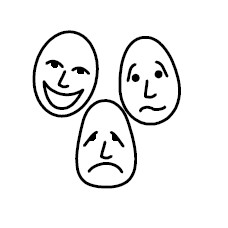
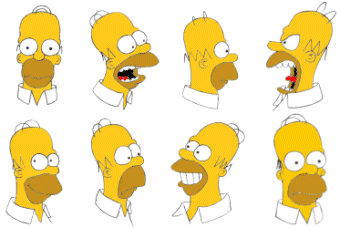
Many autistic children have difficulty interpreting someone’s mood from the way their facial features arrange themselves, my boys are no exception to this general rule. Now that they can speak and use their words occasionally they will ask a pertinent question such ‘are you mad?’ [translation = angry] Curiously this isn’t generally because I am wearing an angry face. [translation = perish the thought that my cheerleader face might slip]

No, it’s much more important than that. I think it’s because they either recognize that they have transgressed [translation = made a less than perfect choice] and or that they have concerns as to how I, their mother, might feel about that behaviour. [translation = rats to the theory of mind] [ref – see previous post]


I know that there are a great many children who have similar difficulties without the label that my children have. You’ll see them on the playground at recess. Some poor benighted child takes a tumble and another child laughs. The child who laughs isn’t necessarily playing with the one that falls down. He may be entirely unconnected with the other group at play, he just notices the fall. He has a visceral reaction what he observes but his synapses direction him to the wrong response because his ‘pity/concern’ category is either misfiled or under developed. The reaction most readily retrievable is the ‘laugh’ response.

You doubt me? I do too. But if you examine your own behaviour, very occasionally someone will tell you something and all you can come up with is ‘the nervous laugh.’ [translation = except Brits who are never nervous and always have the stiff upper lips firmly in place] It’s the same underlying principal for us all. We know we ought to react, not quite sure how, and we leak a giggle instead. [translation = with the exception of Brits who refuse to react to anything without prior permission in triplicate]

He practices his facial expressions in front of the mirror. It’s o.k. if I observe this child, the littlest one, as he doesn’t have strong feelings about me watching him occasionally. It’s the other one that explodes with outrage if he catches me watching him. [translation = it must feel like spying whilst you’re experimenting with something new, in private, until you are comfortable enough to permit a public audience] For a long time senior son refused to look at photographs of people’s faces, it was one of the many triggers for a major meltdown, along with teddy bears amongst other things. If you are a child then it is quite remarkable for an adult to realize just how many teddy bears there are in a child’s life, but you learn this very rapidly as your child identifies every single one of them, wherever you happen to come across them, and demonstrates that he has correctly managed to find even the most obscure ones, by melting down in a catastrophic tantrum.


This kind of behaviour makes even the simplest of task outside your own teddy bear free zone house, a game of chance. [translation = a crap shoot / shute?]
It might seem a little grim, but it was a vast improvement on the period just prior to that, when the word ‘teddy’ wasn’t in his non-verbal filing system. Curiously, Pachycephalosaurs and all his relatives, were neatly catalogued for easy and frequent use. I can tell you with confidence that in everyday life, you are likely to come across at least 100 teddies for every one non specific dinosaur, it’s a statistical fact. [translation = do not challenge me, I know I am right from evidence I the field]

I attempt reinforcement with junior and his mirror, “that’s a very happy face you have there!”
“It’s not a happy face, it’s a straight line, see!” I look. His mouth is straight, a tight line but his eyes are cartoons of surprise. “Perhaps you are surprised?”
“No, I try surprise. That’s too difficult for me.”
“So what face do you have now?”
“I don know. A happy face with a straight line mouth.” I watch him part his lips, reveal his teeth as if to check for lipstick, then purse them closed again. He snaps them open and shut again, watching the effect.
Another curious aspect of this discomfort with images of the human face, is that mirrors, [translation = not that we have many of them] were avoided. Senior son would try and cover them up, obscure them, so that he wouldn’t accidentally catch a glimpse of himself. The shock of seeing himself unexpectedly always produced a meltdown. Translation = an assault of surprise] In the summer when panes of glass shifted their aspect in the sun, they too became substitute mirrors, but it took me a long time to work out his sudden aversion to doors and windows.


Junior lets his chin drop to his chest, despondent, “I never get it right!” he sighs. If I knew what he was attempting to mimic, I might be able to help him. Hopefully whatever emotion he is trying to convey, won’t require me to role play ‘smiling,’ because if I smile and reveal my braces, this might be detrimental to his comprehension. [translation = negative reinforcement]

His older brother has made a lot of progress in the last three and a half years. The innocuous smiley faces that he encounters daily are no longer abhorrent. He advanced to cartoon faces over a year ago, but only if they were line drawings, black and white. We pushed him forward to accept colour versions, and gradually, minutely, stepped into the world of photographic faces. It’s not something that he enjoys but the main purpose would to prevent the heart failure he experienced, whenever such an image jumped out and accosted him. Mirrors are no longer an object of fear, he can tolerate their existence, can choose not to look into them rather than expressing his displeasure in a sociably unacceptable manner.

I turn my attention back to junior as his manipulates his bottom jaw with the assistance of his hands, as he doesn’t have a great deal of muscle strength in that area.
“What are you trying to do dear?”
“I happy? I sad? I mad? I surprised? What I am?” Seems more like curiousity than anything else to me.
“I think you’re happy. Are you practicing a happy face?”
“No. I practice my face. It is the lips or the chin that makes the smile?” A reasonable enquiry under the circumstances, but I hope that he doesn’t delve too much further, as I haven’t passed human anatomy 101.
“It’s the lips dear?” He pouts, purses and preens, testing out the hypothesis.
“You know?..... it not dah lips, it’s dah muscles that are moving the lips underneaf dah skin.”

Ah! I stand corrected, as usual.


Monday, November 27, 2006

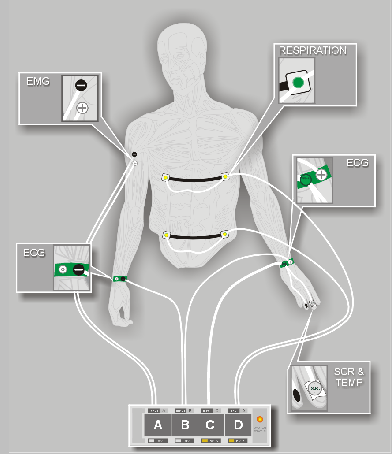
Bio-feedback

Many moons ago my child, when I was just a wee young thing….I would sign my name in the book as I arrived at work at the bank, where I was am employee, every working day. On one strange day, I was called into the under manager’s office. [translation = always a bad sign] He displayed the ‘sign in book’ because this was in the days before the ‘clock in’ machine. [translation = or possibly something more to do with snobbery, the ‘trade’ v. ‘profession’ debate.]


“Well McEwen!” he said in a fatherly tone. “What do you have to say about this?” He riffled the pages and pointed to my signatures. Week upon week, there is was, my own personal scribble. I sought clues. None were forthcoming.

He prompted, “don’t you see?”
“Er, I’m not on time every day?’ I squeaked.
He snapped the volume closed and sighed,
“what is it about Wednesdays?”
“I don’t know? What is it about Wednesdays?”
“Every Wednesday you have a squiggle.”
“A squiggle?”
“This is not your signature, just a squiggle.
Every Wednesday for nearly a year. What is it about Wednesdays?” [translation = what exactly preceded the observed event? N.B. See how much I have advanced since those days of youth?]
I didn’t know then, I don’t know now. I suspect it’s something to do with circadian rhythms or some other phsychobabbledom.


Today nearly thirty years later I am struck by a curious thought. That bank manager was a Brit, three decades ago? What kind of a bank manager was he? A rare breed. Someone sufficiently in tune with his employees, to even notice such a detail in the first place.


I notice traffic on the web.
Alerts are quiet.
What do you do on a Wednesday?
Mid week.
Not the ‘get into gear Monday’ nor the ‘wind down Friday.’
Think about it? What is it about Wednesday? I can see the evidence of my own eyes. What did you do today? How did you feel? What makes Wednesday different from Tuesday or Thursday? Is Wednesday the forgotten day? Is your battery flat?
Is it in limbo?
Why?
Don’t ask me.
I have no answers. Only questions.

Early onset

[translation = here sooner than anticipated {sub translation = senility, that is to say}]

Oooo enough of this ‘hidden disease’ malarkey. Far too tiresome, and certainly anything but hidden. It’s all to obvious around here I’m afraid. There might be many reasonable and logical explanations for what you might observe in the confines of this, our home, but the most obvious cause is autism.

How do I mean? Well, lets start with a small example and we can compare notes. Sounds like a plan? Good.

Here are the basic ingredients. [translation = add or subtract as you deem fit. {sub translation = minus}] Take one child or the smallish variety, ideally male. [translation = lower incidence ‘female.’] Sprinkle the following substances over the said child and observe reaction. [translation = for some subjects it is best to avoid the ‘head and shoulders’ area with there is a higher incidence of receptors]


Take and eye dropper. [translation = haven’t the foggiest, please supply at your earliest convenience] Fill with blood temperature water. Drop one droplet on subject. [translation = insert earplugs prior to commencement]


Take talculm powder and drift one siftlet over the child at a height of approximately 5 feet above head. [translation = a step ladder may prove useful for this portion of the programme.]


Thirdly, expose child to the sound of the fire alarm sensor. [translation = the soft beeping noise that the contraption emits when the batteries are low] Ensure that the device is the greatest distance possible from the said child. Do not be alarmed that you are unable to really hear the same noise yourself, until you are standing 3 feet beneath the dratted machine.


Fourthly, take your favourite foodstuff. [translation = any one will do, just as long as it is universally agreed by mankind, that it is delicious] Ask subject to a] look at food. B] smell food. C] touch food [translation = not necessarily with finger, due to tactile defensiveness] D] lick food. E] taste or eat food. Let me know if you get past A].


Lastly, try and cuddle subject when he’s not expecting it. [translation = bandages are in the bathroom]

Advanced programme. [translation = program {N.B. not for the faint hearted.}] Repeat as above, but this time use yourself as the subject. Observe the enhanced agony of your child, as you expose yourself to the same elements. [translation = cannot put oneself in another’s shoes {sub translation - rats to the theory of mind}] [See Ref 1] If the observer of the subject reacts as follows:

“No, no, no. Doe not do dat! Agh! Agh! Agh! You will be hurted! No! No! No! I will hep you!” then you may gain some small reassurance that the theory [as set out below] is not always the case. [translation = in all situations] It is sad, as always, to observe the callous attitude of the mother. [translation = prima gravida]

Have I convinced you?

Oh! You think it’s more ‘sensory integration issues and a bit of speech delay’ huh! Or maybe you adhere to the theory that he's a wimpy little nerd who needs to 'shape up?' A valid observation as always on your part. Luckily we’re all entitled to our biased opinion. [translation = especially me]


A child with too many nerve endings? [translation = maybe just a bad wiring job]

{sub translation = whoop de doo!
/jolly good show Mr. Eye Contact}


[Ref 1] The Theory of mind from Wikepedia [thank you] According to Simon Baron-Cohen et al,[7] [ translation = I love him and all his pals really] many autistic children appear to lack a "theory of mind," which is the ability to see things from another person's perspective. This is a behavior cited as being exclusive to human beings above the age of five and possibly, to a lesser degree, to other higher primates such as adult gorillas, chimpanzees and bonobos.[citation needed] Typical 5-year-olds can usually develop insights into other people's knowledge, feelings, and intentions based on social cues (e.g., gestures and facial expressions). An autistic individual may lack these interpretation skills, leaving them unable to predict or understand other people's actions or intentions. [translation = a load of old codswallop {Sub translation = rhubarb}]

Sunday, November 26, 2006

Sleepless in San Jose


The trouble with sleeping pills, amongst many other things, is they are not dispensed in hourly doses. [translation = one pill induces 8 hours of sleep] If the standard eight hours of sleep are not available to you this means that you will spend between 3 and 4 hours, vertical but in a fog.


One solution to this problem [sorry – challenge] is to ensure that the parent sleeps when the child [ren] do. If the child [ren] sleep for 8 to 9 hours, then this would be the ideal time for the parent to do likewise. I acknowledge the sense in this approach, but fail to observe it. [translation = ignore it] Instead I choose to spend approximately 4 hours from 8ish to midnight ish, awake and child free.


The net result of such a choice is that after my head has been horizontal for about 4 or five hours, I am suddenly forced to be vertical again, as they all wake up at that hour in the morning. [translation = rats to Daylight Saving] ‘Well more fool you’ I hear you cry. ‘You should pay more attention to your bio-rhythms dearie!’ and as usual you’d be completely right, although I’d prefer the message without the psychobabble. [translation = if you provide me with that option]


No, as I see it, the solution is twofold;
1. Ban Daylight Saving [translation = far too radical and likely to cause lots of car accidents]
2. Manufacturers should produce sleeping pills in hourly doses. [translation = cheaper and would reduce the suicide rate by 99% overnight {sub translation = or in the daytime depending upon when the crisis of conscience occurs}]
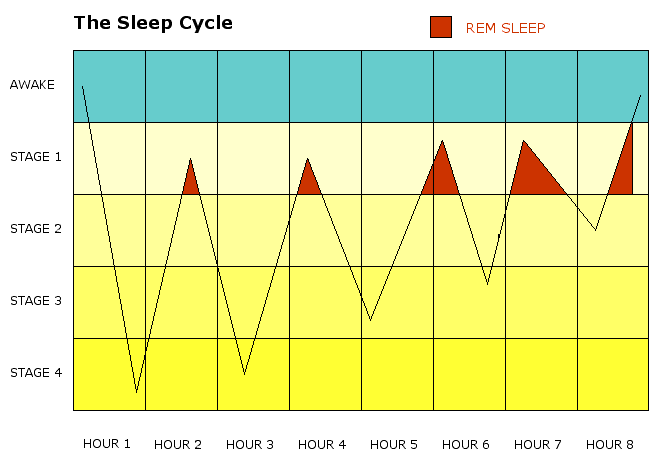
Studies have shown that……oh we won’t bother with them. I just need more REM sleep. [translation = red is my favourite colour afterall]


Now if you’ll excuse me, I have to nip off and clean the bifocals, as I believe that may be a contributing factor to the fog. [NB it would be a good idea to remove the ear plugs too]

 
AddThis Social Bookmark Button